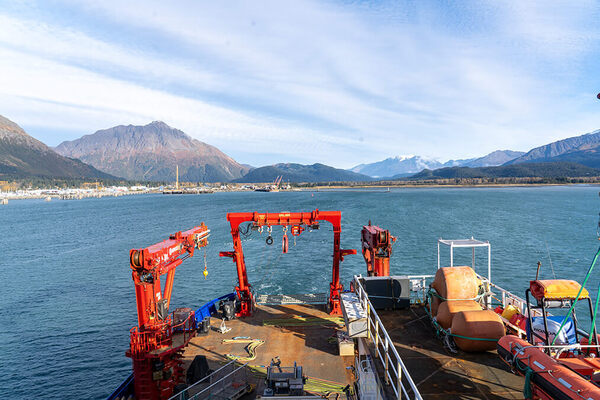
In October 2025, two sibling U.S. National Science Foundation (NSF)-funded centers had representatives aboard Research Vessel (RV) Sikuliaq: Trusted CI, the NSF Cybersecurity Center of Excellence, and NSF CI Compass, the NSF Cyberinfrastructure Center of Excellence. RV Sikuliaq was set to transit from Seward to Nome, Alaska, after a maintenance phase. Each center has worked with Sikuliaq on its cyberinfrastructure (CI) systems and cybersecurity protocols. The planned transit would have provided an opportunity for a cybersecurity check-in on the systems, and especially for both centers to spend time learning from and speaking with the ship’s IT manager, Julian Race.
While on board the ship in October, Sikuliaq faced maintenance work that had to be completed before the trip could commence. The visiting teams spent their time on Sikuliaq in port in Seward, observing how the ship’s crew conducts and adapts their work when plans change.
Sikuliaq, owned by the NSF and operated by the College of Fisheries and Ocean Sciences at the University of Alaska Fairbanks (UAF), is a part of the U.S. Academic Research Fleet (ARF). The ship is equipped for big data collection, with servers and network infrastructure built to store data from oceanographic, marine research, navigational, and sensing instruments. Its data-gathering science mission takes researchers to what is sometimes referred to as “edge environments,” where there is minimal noise and light pollution, and no human presence at all. In these remote environments, the cyberinfrastructure (CI), or computer hardware and software buildouts, and cybersecurity to keep those CI systems secure, become a unique challenge to support. Additionally, much of the data collected by the ship’s instrumentation eventually becomes open for public use. The data collections are not inherently sensitive, but are sometimes subject to embargoes or use by governing agencies.
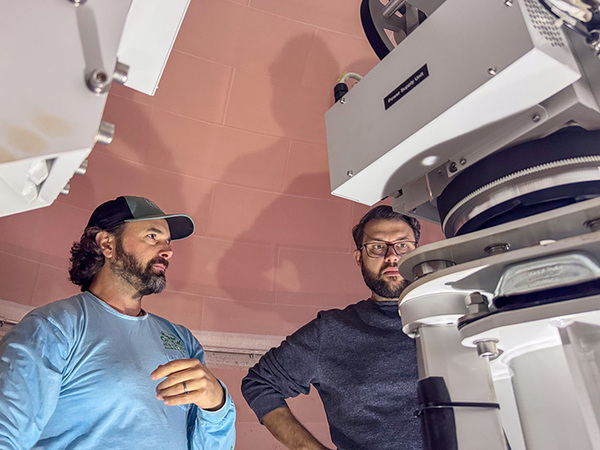
“Our mission is to learn how to support the CI practitioners at NSF Major and Mid-scale facilities. Research vessels in the NSF-funded ARF and Regional Class Research Vessels (RCRV) are unique in that the CI onboard is competing for space with instruments, crew, and scientists. These systems need to be efficient and robust, as they operate in difficult physical environments that test the CI on board in profound ways,” said Ewa Deelman, director of NSF CI Compass, research professor of computer science at the University of Southern California (USC), and principal scientist at the USC Information Sciences Institute. “Working with Julian, and others onboard, we see the ways they have put together systems to efficiently store and transmit scientific data. We can then work with them to find ways to monitor and improve that performance and help ensure these RVs can continue their research missions for years to come.”
NSF CI Compass’s Christina Clark was on the ship to observe the CI integrated into the ship and gain insight into the cybersecurity side of the challenges RV Sikuliaq must address. NSF CI Compass’s team has worked through the years with the Regional Class Research Vessels, ARF, and RV Sikuliaq to learn about these needs, and update and maximize the capacity and output of these systems.
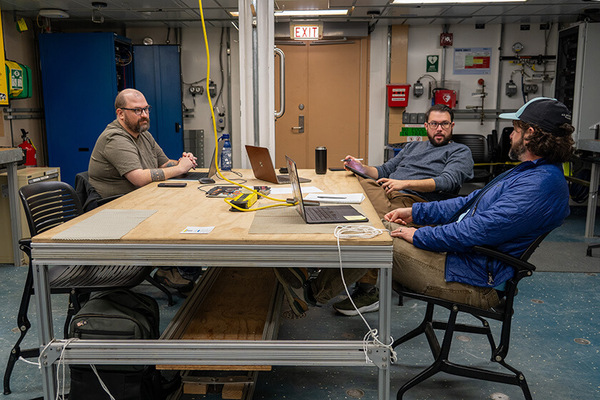
Josh Drake serves as director of security operations and services for OmniSOC and REN-ISAC and is a member of the Trusted CI team. OmniSOC operates the ARF Security team and uses the Trusted CI Framework in its approach. Drake was sent to Sikuliaq to represent OmniSOC, which has a three-year contract to provide systems and network monitoring and cybersecurity consultancy services to ARF. Drake’s mission was to set up and run a cybersecurity tabletop exercise.
“Our plan was to test the vessel’s crew’s ability to respond to security incidents while the ship is underway, and have them work with OmniSOC on the incident response,” Drake explained. “The primary goal is for the ship’s technicians to identify where we have made incorrect assumptions around capabilities and procedures so that we can be more accurate with our response and revise procedures going forward.”
Also on board Sikuliaq was Logan MacDonald, manager of security operations, systems office, with the Office of Information Technology at the University of Alaska. MacDonald’s mission was to do a risk assessment audit for the University and learn more about the ship itself.
“We want to become more adept at helping our research partners and understand their challenges,” MacDonald said. “I’ve worked with Julian for a while, and this was the first opportunity for me to get insight into the actual ship. There are unique needs in this environment we have to support.”
NSF CI Compass and Julian Race have worked together to support Sikuliaq’s CI, addressing network monitoring, improving connectivity, and working with the CI that must have a longer lifespan as part of the stewardship of its funding from NSF.
“We have server racks all around the ship, and they’re all doing different things,” explained Race. “We keep spare servers, so that if we have a catastrophic loss of our data center, we can pull backups of all of our virtual and physical machines and restore them to a spare to get us back online.”
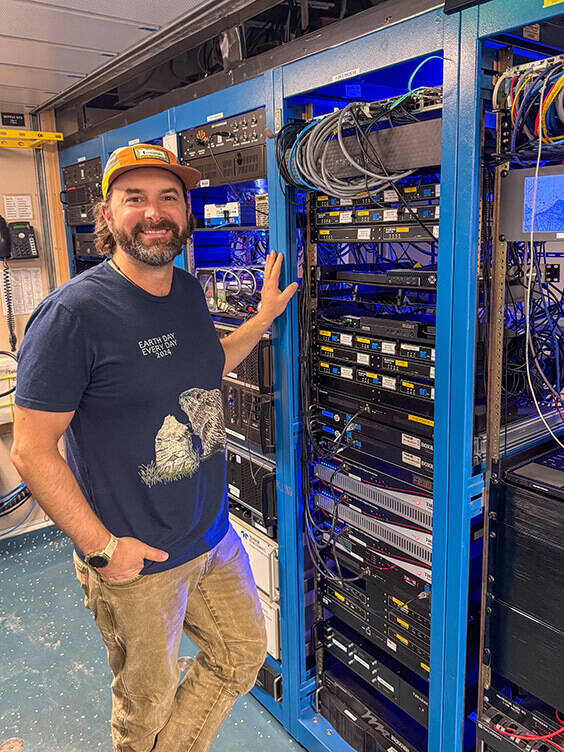
NSF centers like NSF CI Compass and Trusted CI continue to learn from the ship’s crews and their experiences, just like Race learns from the CI and cybersecurity specialists in each center – even when plans change.
RV Sikuliaq and its crew embarked on the planned science mission, albeit a little truncated, about a week and a half after Clark, Drake, and MacDonald departed the vessel.
“I gained a much deeper understanding of the work that goes into maintaining and executing research on an RV like this,” said Clark. “From the ship’s captain to the newest marine research technician on board to the IT manager - no one had a shortage of duties to perform while the ship was delayed and preparing for its next trip. This was also an opportunity to make sure systems are all running at top performance, while the crew has access to supplies on shore.”
NSF CI Compass provides expertise and support to CI practitioners in the NSF Major and Mid-scale research facilities. To learn more about the center, please visit ci-compass.org
Since the cruise, the former OmniSOC contract with ARF concluded in March 2026. OmniSOC received an NSF award to support cybersecurity operations for the fleet for the next five years in April.
Photos by Christina Clark, NSF CI Compass, Notre Dame Research
About NSF CI Compass
CI Compass is funded by the NSF Office of Advanced Cyberinfrastructure in the Directorate for Computer and Information Science and Engineering under grant number 2127548. Its participating research institutions include the University of Southern California, Indiana University, Texas Tech University, the University of North Carolina at Chapel Hill, the University of Notre Dame, and the University of Utah.
To learn more about CI Compass, please visit ci-compass.org.
Contact: Christina Clark, Research Communications Lead
NSF CI Compass / Notre Dame Research / University of Notre Dame cclark26@nd.edu / 574.631.2665