The U.S. National Science Foundation (NSF) Major and Mid-scale research facilities (MFs) tend to be located in “edge” environments, where science is conducted in remote areas. The MFs typically operate far away from the noise and light pollution of cities, in areas with unobstructed views of the sky, readings of the Earth’s movements, or access to shorelines and the ocean. These structures come with unique buildouts that serve as each facility's on-premise (on-prem) data centers, before the data can be moved and made available to researchers and scientists. These MFs are built with very specific environments in mind – some even collect and process data traveling across the oceans.
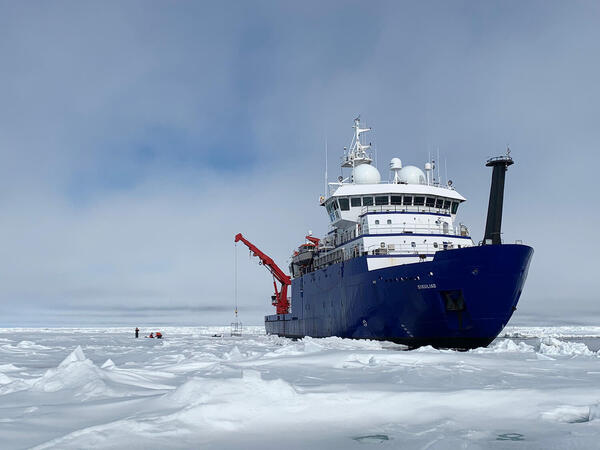
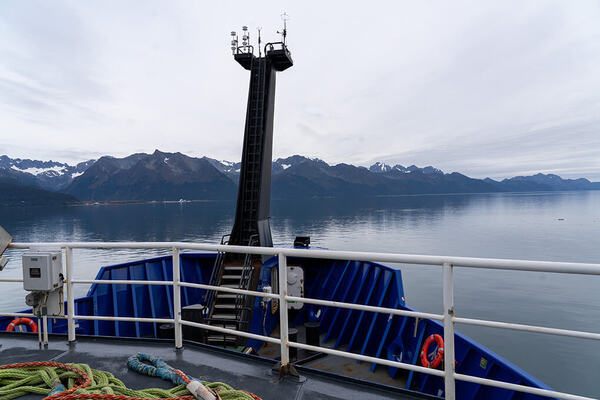
The NSF Research Vessel (RV) Sikuliaq, pronounced [see-KOO-lee-auk], is a scientific vessel used to host research teams and store data until it can be safely transmitted. The ship, owned by the NSF and operated by the College of Fisheries and Ocean Sciences at the University of Alaska Fairbanks (UAF), with a home port of Seward, Alaska, is a part of the U.S. Academic Research Fleet (ARF). The ship’s construction began in 2009, and it has been operated by UAF since 2014. Cyberinfrastructure (CI) on board is managed by a dedicated IT department in addition to a team of research vessel technicians.
“Our science is data collection,” said Julian Race, IT Manager of RV Sikuliaq, about the ship’s functions. “Often, the funded science mission brings along measurement apparatus external to the ship’s own sensors. We are always doing our own onboard measurements and data collection like oceanographic and atmospheric readings. These two types of data acquisition happen simultaneously. We bring them all together into our data set.”
RV Sikuliaq travels from the Arctic Circle all the way down the Pacific Ocean to Antarctica. It can navigate rough waters like the Bering Sea, taking research teams wherever they need to be to gather data. It embarked on its first Antarctic mission in 2025.
“There is no building, like a ship, that rolls 20 degrees to either side several times a minute,” said Race. Like other NSF MFs, the vessel has had to be built to adapt to the unique conditions it encounters.
Big data collection
The ship’s mission is to constantly collect data.
“The data collected from the surface water flow-through system is transmitted to the shore all the time, about three seconds after it’s collected,” said Race, describing data that is provided in “best effort” real-time. A focus of Race’s job is to make sure that the acquisition and delivery of data is possible, especially given often challenging conditions.
The ice-breaking capabilities of the ship are used only when absolutely needed, as preserving the natural environments the ship and its crew encounter is important to its mission, as well as reducing fuel consumption.
“We generally try to use remote sensing from satellite imagery and radar satellites to look for leads and areas where there is less ice,” said Race. “We rely on our cyberinfrastructure and our internet connectivity to get remote sensing support from the National Ice Center.”
As a part of the ship’s mission, the public has access to the data collected by its instruments. The current view from the ship’s bridge is updated frequently on the ship’s data website to allow the public to see the environment in which the data is being collected.
In addition to the CI onboard supporting instruments collecting marine and oceanographic data, there are systems that monitor the ship's propulsion, navigation, and life safety systems.
Science as a team sport
The vessel’s mission and CI needs brought Race together with the NSF CI Compass team to work through its unique challenges. The NSF CI Center of Excellence is a leader in supporting and enhancing the national CI ecosystem, facilitating knowledge
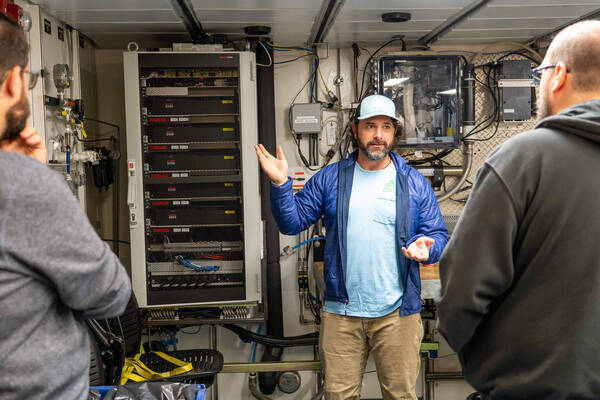
sharing and discovery across the NSF MFs. NSF CI Compass addresses various CI stages throughout the data lifecycle, which includes specific stages that data flows through an MF, from a research instrument’s data capture to access, dissemination, and use by a broad group of stakeholders in digital environments. Members of NSF CI Compass, including Ewa Deelman, director of the center, research professor of Computer Science at the University of Southern California (USC) and principal scientist at the USC’s Information Sciences Institute (ISI); Nicole Virdone, director of outreach for NSF CI Compass, Mahedi Hasan, research assistant for the center, and doctoral candidate at the College of Media and Communication at Texas Tech University, and Christina Clark, communications lead for NSF CI Compass and research communications shared services program director at Notre Dame Research, have recently been onboard RV Sikuliaq to view the ship’s CI infrastructure and participate in transits. Deelman and Virdone visited the ship to learn about its CI challenges while it was in port in Hawaii. Hasan and CI Compass Student Fellow alumni Raymond James Gallant joined a transit cruise from Hawaii to Alaska, performing cybersecurity exercises and observing science as a team sport. Clark joined the ship on a stay in its home port of Seward, Alaska, to meet with Race, and learn about the daily life onboard a research vessel, and observe the cybersecurity and CI built into the ship.
NSF CI Compass formally engaged with RV Sikuliaq and the Regional Class Research Vessels (RCRV) to learn and solve challenges in on-board and on-shore CI that measures the ship’s wide area network bandwidth as it conducts its science cruises. The measurements and knowledge help to inform those managing the CI to enhance the support for data collection, monitor the ship’s operations, and better manage daily life on-board for crew and visiting scientists.
In January 2026, “Ship-to-Shore Networking Monitoring: The Research Vessel Sikuliaq Experience” was published in IEEE Internet Computing. The paper, authored by Race and Deelman along with Komal Thareja, distributed systems software engineer, for the network research infrastructure group (NRIG) at the Renaissance Computing Institute (RENCI) at the University of North Carolina, Chapel Hill; Anirban Mandal, associate director of NSF CI Compass and director NRIG at RENCl; Paul Ruth, assistant director of NRIG at RENCI; and Christopher Romsos, datapresence systems engineer, RCRV, at the College of Earth, Ocean, and Atmospheric Sciences at Oregon State University, analyzes the results from network tests performed after perfSONAR-based network performance monitoring systems were deployed on RV Sikuliaq in April 2025. The paper brought together members of NSF CI Compass (Deelman, Mandal) and RV Sikuliaq (Race), NSF FABRIC programmable network testbed (Ruth, Thareja) as well as personnel of the Regional Class Research Vessel (RCRV) at Oregon State University (Romsos).
In 2022, NSF CI Compass began working with U.S. ARF and RCRV to minimize the time between data capture and analysis. In 2023, NSF CI Compass publicized its work with Romsos and the RCRV, especially RV Taani, being built by Oregon State University.
At that time, the goal was improving connectivity onboard RVs while they were still under construction and making sure the physical infrastructure was powered to its full potential, while remaining seaworthy. Each ship has to accommodate its data collection, storage, and transmitting abilities while at sea and in port.
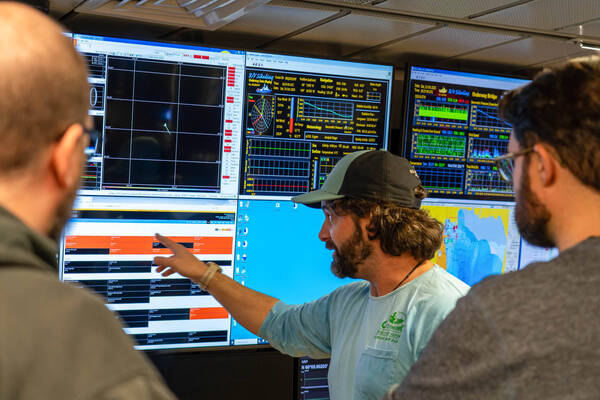
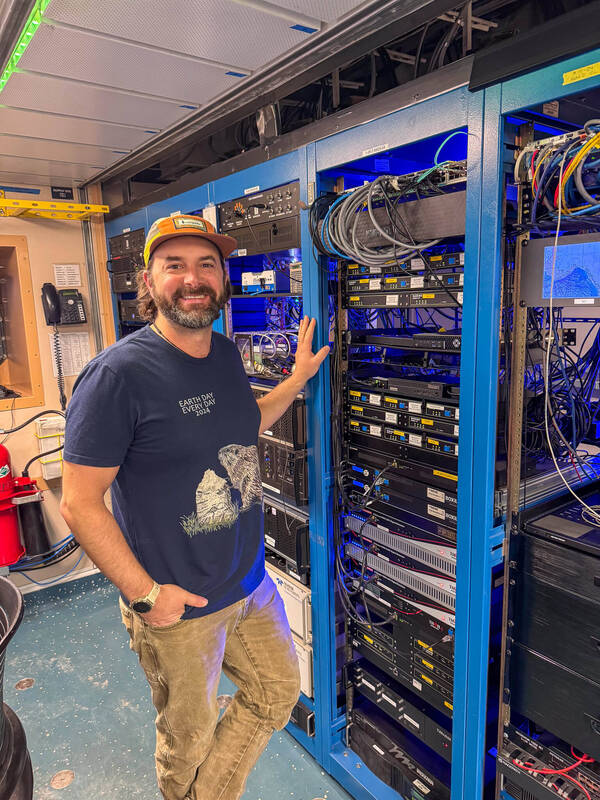
On the outside of the ship, Sikuliaq has a reinforced hull that is capable of breaking sea ice as it cruises the northern-most and southern-most waters on the globe. The ship carries multiple oceanographic winches and two cranes for the handling and deployment of instruments and vehicles. On the inside, there are a plethora of screens in the electronics and computer lab displaying constant readings and views of the decks. Familiar computer racks are tucked to one side of the room, where much of the computing on board is connected. These racks are fitted and constructed in ways to absorb the shocks of the usual motion of the ship, as well as the swells that can rock the vessel and test its stabilizing capabilities.
And much like other NSF MFs created for a specific type of research, the technology begins to age almost as soon as it is installed.
“We have some computers that have been running for ten years, requiring constant monitoring, spares, and recovery plans,” said Race.
With the pace of new developments and rapidly transforming best practices and protocols, maintaining data, keeping it usable and accessible across platforms, and archiving it appropriately are all challenging parts of the Data Lifecycle that RVs like Sikuliaq deal with.
“Working with Race and the team at Sikuliaq has given us more information on how RVs function, move around the world, and the challenges present with data storage, movement, and even security in the process,” said Deelman. “We continue to look for ways to partner with the RVs and CI practitioners doing ocean sciences to better steward the ‘oceans’ of data they collect.”
NSF CI Compass continues to partner with MFs to assess existing CI, and find solutions to challenges that come up in the data lifecycle processes. In January 2026, NSF CI Compass hosted its AI Meets CI Virtual Workshop, focusing on intelligent infrastructure for MFs. The event brought together practitioners of CI across many research disciplines within the NSF community, where attendees could learn from one another’s experiences.
Learn more about NSF CI Compass’s mission and work here: https://ci-compass.org/about/
About NSF CI Compass
CI Compass is funded by the NSF Office of Advanced Cyberinfrastructure in the Directorate for Computer and Information Science and Engineering under grant number 2127548. Its participating research institutions include the University of Southern California, Indiana University, Texas Tech University, the University of North Carolina at Chapel Hill, the University of Notre Dame, and the University of Utah.
To learn more about CI Compass, please visit ci-compass.org.
Contact: Christina Clark, Research Communications Lead
NSF CI Compass / Notre Dame Research / University of Notre Dame cclark26@nd.edu / 574.631.2665