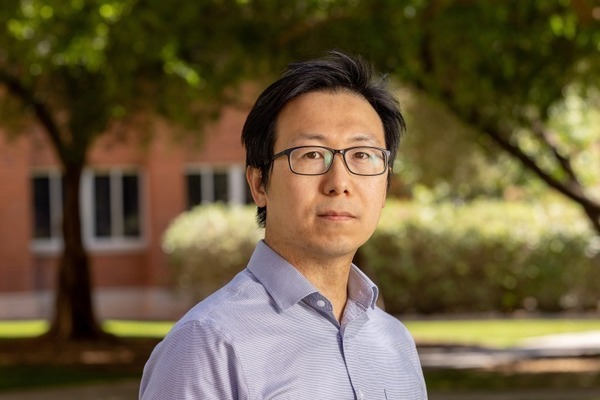
NSF CI Compass is pleased to welcome our next webinar guest Chi-Kwan "CK" Chan, Associate Astronomer and Professor at Steward Observatory and the Department of Astronomy at the University of Arizona.
Chan will be presenting "Resolving a Black Hole: How OSPool and Pegasus Power the Event Horizon Telescope."
This webinar will be hosted on Tuesday, September 8, 2026, at 1 p.m. ET | Noon CT | 11 a.m. MT | 10 a.m. PT.
Registration is free, and required to attend.
Abstract:
The Event Horizon Telescope links radio telescopes around the world to create an Earth-sized virtual telescope capable of imaging black holes. In this webinar, I will explain how the EHT produced the first images of M87* and Sagittarius A*, what we have learned, and why extracting more science from these observations requires large-scale computing. I will then show how Pegasus organizes SYMBA simulations across OSPool, producing a vast library of realistic mock observations that include the effects of the atmosphere and instruments. These data are used to train ZINGULARITY, an uncertainty-aware neural-network framework that connects EHT measurements to properties such as black hole spin and the behavior of surrounding gas and magnetic fields. This approach allows us to test far more models, use more of the information in the data, and quantify how confident we are in the results.
Bio:
Dr. Chi-kwan "CK" Chan is an Associate Astronomer and Research Professor at Steward Observatory and the Department of Astronomy, University of Arizona (UArizona). He served as the Secretary of the Event Horizon Telescope (EHT) Collaboration Science Council from 2020 to 2022. He recently led the publication of the computational and theoretical modeling/interpretation of our black hole, Sgr A*. Dr. Chan created the collaboration's computational and data processing infrastructures and continues to manage them to this day, along with leading both the Software and Data Compatibility and the Gravitational Physics Working Groups in the collaboration. He is a faculty member and a steering committee member of the Theoretical Astrophysics Program (TAP), a co-lead of TAP Computation and Data Intuitive (CDI), a faculty member of the Applied Mathematics Program and Data Science Institute, and serves as the vice-chair of UArizona Research Computing Governance Committee (RCGC). In addition to pioneering the use of Graphics Processing Units (GPUs) to accelerate the modeling of black holes, Dr. Chan also developed many new algorithms to improve and accelerate modern astrophysics research, built cloud computing infrastructures for large observational data, and applied machine learning algorithms to speed up and automate data processing. Dr. Chan has taught and mentored in subjects of machine learning, numerical analysis, cloud computing, and quantum computing; biked across the U.S.; and is an avid hiker.