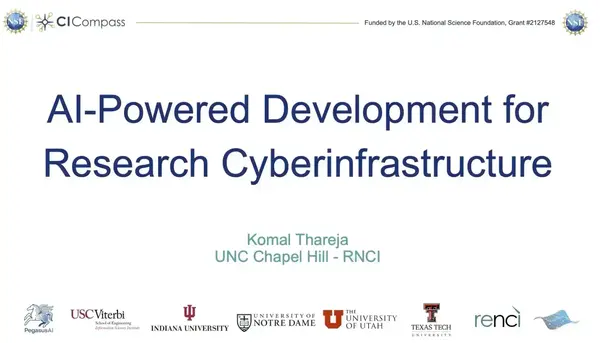
NSF CI Compass invites you to the next installment of our webinar series, "AI-Powered Development for Research Cyberinfrastructure, Part 2," featuring Komal Thareja, senior research software engineer at RENCI, University of North Carolina at Chapel Hill. Thareja leads the development of FABRIC's core platform capabilities.
This webinar will be held on Tuesday, July 21, at 1 p.m. ET | Noon CT | 11 a.m. MT | 10 a.m. PT.
This event has passed.
Abstract
AI coding assistants are changing how research software is developed, tested, and maintained — but most guidance targets industry, not the research cyberinfrastructure community. This webinar
bridges that gap with practical demonstrations tailored to CI roles: scaffolding scientific workflows, generating APIs from OpenAPI specifications, building project dashboards from publication data, and creating presentation materials — all using real examples drawn from NSF Major Facility cyberinfrastructure projects. We address each audience — PIs and managers, developers, and students — with workflows they can adopt directly.
This session will be a continuation of AI-Powered Development for Research Cyberinfrastructure, Part 1, which was given on May 13, 2026 and can be viewed here: Part 1.
It will cover what AI gets wrong, prompt engineering techniques that improve results, and security considerations for working with research code. No prior experience with AI tools is required.

Bio
Komal Thareja is a Senior Research Software Engineer at RENCI, University of North Carolina at Chapel Hill, where she leads the development of FABRIC's core platform capabilities — from advanced networking services and heterogeneous accelerators to distributed storage and experiment orchestration — and contributes to CI Compass initiatives spanning Pegasus workflow management, network monitoring, and AI-assisted software development. Her current research explores the convergence of distributed intelligence, multi-agent systems, programmable networks, and AI-driven scientific workflows, with a focus on enabling large-scale, reproducible experimentation across edge, network, and cloud environments. She brings years of industry experience architecting large-scale systems in the communications sector, grounding her research in production-grade engineering discipline.
About NSF CI Compass
CI Compass is funded by the NSF Office of Advanced Cyberinfrastructure in the Directorate for Computer and Information Science and Engineering under grant number 2127548. Its participating research institutions include the University of Southern California, Indiana University, Texas Tech University, the University of North Carolina at Chapel Hill, the University of Notre Dame, and the University of Utah.
To learn more about CI Compass, please visit ci-compass.org.
Contact: Christina Clark, Research Communications Lead
NSF CI Compass / Notre Dame Research / University of Notre Dame cclark26@nd.edu / 574.631.2665